
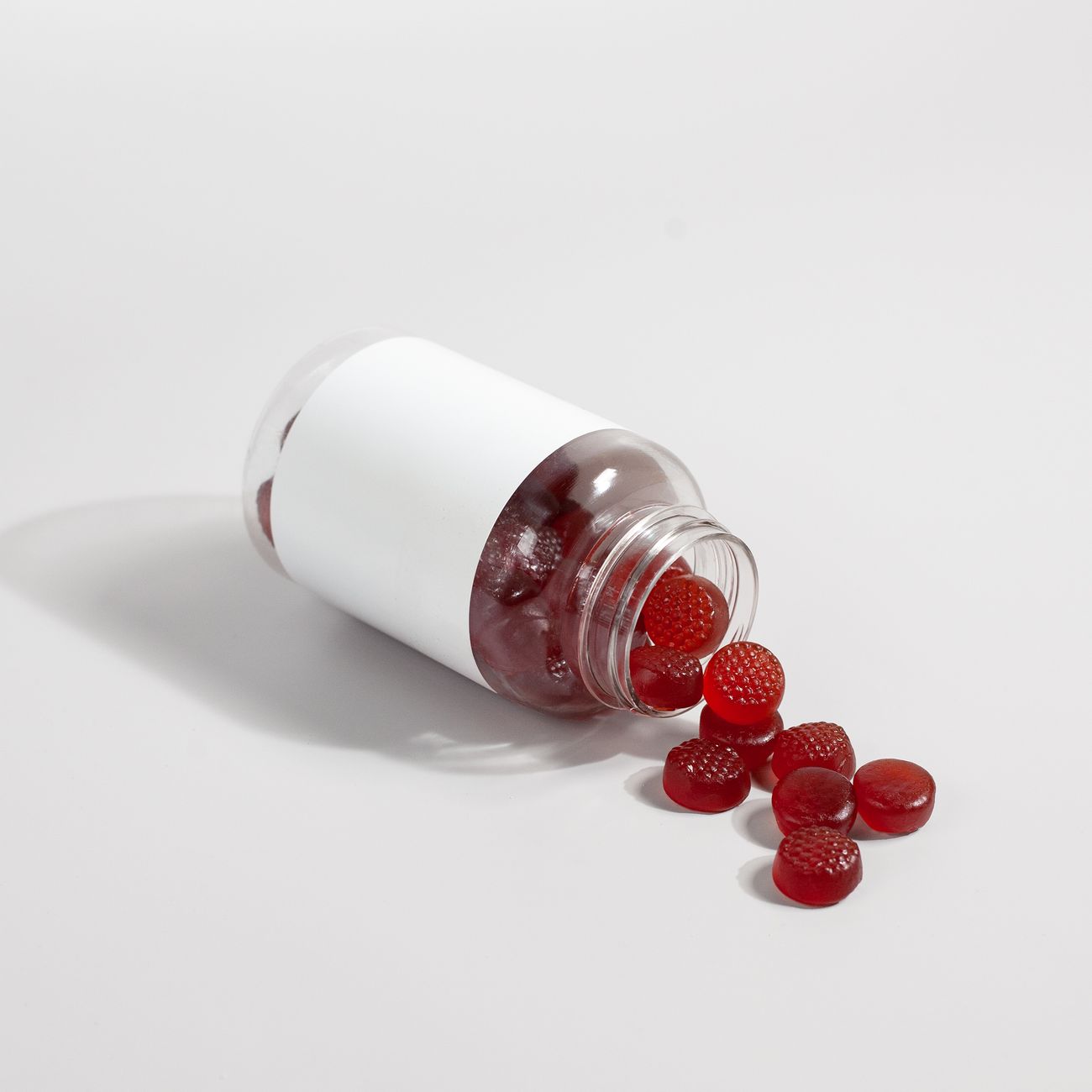
Quick answer: In theory yes, in practice often no. Creatine itself works in any format, but creatine is hard to keep stable in a gummy. In two rounds of independent lab testing, roughly half the gummy brands tested contained less creatine than their labels claimed, and some contained almost none. Gummies also cost far more per dose and would need many pieces to reach 3–5 g. Powder remains the reliable choice.
Gummies are so appealing. No shaker bottle, no gritty coffee, no measuring. Just chew and go.
We wanted them to work. Then the lab results came in.
(For every creatine format, see Types of Creatine Explained)
The problem: creatine doesn’t like sitting in moisture
Creatine slowly converts into creatinine, an inert waste product your body just excretes, when it sits in water. The process speeds up with heat and acidity.
Now think about how a gummy is made: creatine is mixed into a hot, wet, often acidic syrup, poured into molds, cooled, and then sits on a shelf for months before you eat it.
That’s the same reason pre-mixed liquid creatine isn’t recommended. A gummy is, chemically speaking, closer to liquid creatine than to powder.
This is a manufacturing problem, not a reason to distrust creatine itself. Some companies may solve it. Testing suggests many haven’t.
What the lab testing found
Test 1: NOW Foods, 2024
Supplement manufacturer NOW Foods tested 12 creatine gummy brands using HPLC lab analysis (a standard method for measuring supplement content).
- 6 of 12 passed their label claims.
- 6 of 12 failed.
- Every product that fell short also showed detectable creatinine, the signature of creatine that had broken down.
- Three failing bear-shaped products appeared to come from the same manufacturer.
NOW also reported something unsettling about the wider industry: it couldn’t find an independent lab set up to test gummies, at a time when gummies are one of the fastest-growing supplement formats. One brand publicly disputed the findings.
Test 2: SuppCo, 2025
The supplement review platform SuppCo ran its own testing through an ISO 17025-accredited lab, buying 11 products off the shelf: 5 powders and 6 gummies.
- 4 of 6 gummies failed identity and potency testing.
- Two contained no detectable creatine at all.
- Two contained trace amounts, reported as roughly 0.09% to 0.5% of a standard dose. At that level you’d need hundreds to thousands of gummies to get one 5 g serving.
- Even the two gummies that passed showed significant creatinine, meaning some creatine had degraded.
- The four failing products had sold roughly 50,000 units on Amazon in the prior month.
What this means
Two independent rounds of testing, two similar conclusions: gummies are the least reliable way to buy creatine. Not because gummies are dangerous (creatinine is harmless in these amounts) but because you may be paying for creatine you aren’t getting.
Three more problems, even with a good gummy
1. The math rarely works
Research doses are 3–5 g a day. Gummies typically contain 1–1.5 g of creatine each, so a real daily dose means 3 to 5 gummies, sometimes more. Check the label: if it lists 1.5 g per gummy and a “serving” of one gummy, that serving isn’t a research dose.
2. Cost per dose
A month of quality creatine powder runs roughly $12–$15 at about $0.40–$0.50 per 5 g serving. Gummies routinely cost two to five times more per actual gram of creatine, especially once you account for needing several pieces.
3. Sugar and extras
Most gummies contain added sugar or sugar alcohols plus colorings. A few grams of sugar isn’t a health crisis, but it’s daily, and it’s the opposite of what most women want in a single-ingredient supplement.
Powder vs. gummies, side by side
| Creatine powder | Creatine gummies | |
|---|---|---|
| Reliability of dose | High; stable in dry form | Mixed; testing found many under-label |
| Cost per 5 g | About $0.40–$0.50 | Often several times more |
| Pieces per dose | 1 scoop | Usually 3–5 gummies |
| Added ingredients | Often none | Sugar, colorings, gelling agents |
| Convenience | Needs a drink | Grab and go |
| Third-party certified options | Many | Few; labs have struggled to test gummies |
So who should consider gummies?
We’re not absolutists. A gummy you take every day beats a powder that sits unopened in your cabinet. Gummies may make sense if:
- You truly won’t take powder. Adherence matters more than format.
- You travel constantly and want something that doesn’t need a drink.
- You can’t tolerate the texture of powder in any liquid. (First try micronized creatine in a smoothie or coffee, which fixes it for most women. How →)
If that’s you, vet the product carefully.
How to vet a creatine gummy (a 5-point check)
- Recent third-party lab results for that product, ideally a certificate of analysis you can actually view, dated within the past year.
- Grams of creatine per gummy, and do the math for 3–5 g a day.
- Creatinine testing. Ask whether the brand tests for it, since it’s the marker of degraded creatine. Most won’t publish this, which tells you something.
- A real certification (NSF Certified for Sport®, Informed Sport) if you can find one in this format.
- A short ingredient list, with modest sugar and no proprietary blends.
If a brand can’t or won’t show current testing for its gummies, choose powder instead.
What about creatine chews and capsules?
- Chews sit somewhere between gummies and powder, and face the same stability questions. Apply the same 5-point check.
- Capsules are a solid middle ground. Creatine stays dry inside a capsule, so stability isn’t the issue powder-versus-gummy is. The downside is that a 5 g dose can mean swallowing 5–7 capsules, and you’ll pay more than for powder.
The bottom line
Creatine works in any format that actually contains creatine. That’s the catch with gummies. Independent testing in both 2024 and 2025 found roughly half the brands tested fell short of their labels, some dramatically. Add higher costs, multiple pieces per dose, and added sugar, and powder is the clear choice for most women. If gummies are the only format you’ll stick with, demand current lab results before you buy.
Looking for reliable options? See our picks for the best creatine for women.
Frequently asked questions
Do creatine gummies actually work?
They can, if they contain the creatine on the label. Independent lab testing in 2024 and 2025 found that roughly half the gummy brands tested fell short, with some containing no detectable creatine. Powder is far more reliable.
How many creatine gummies equal 5 grams?
It depends on the product. Most gummies contain 1–1.5 g each, so a 5 g dose usually takes 3 to 5 gummies. Always check grams per gummy rather than assuming one serving is a full dose.
Why do creatine gummies lose potency?
Creatine converts into creatinine when it sits in moisture, and heat and acidity speed that up. Gummy manufacturing and shelf life involve all three, which is why testing often finds degraded creatine.
Is creatinine in gummies dangerous?
No. Creatinine is an inert breakdown product your body excretes. The problem is that it means you’re getting less creatine than you paid for, not that it’s harmful.
Are creatine gummies worth the money?
Usually not. They cost several times more per gram of creatine than powder, and the quality record is poor. Their one advantage is convenience.
Are creatine gummies good for women?
Creatine itself benefits women regardless of format, but the same reliability problems apply. If you want the simplest reliable option, choose micronized creatine monohydrate powder. Why →
Keep learning
- Types of Creatine Explained Every form, compared. → /types-of-creatine/
- Can You Mix Creatine in Hot or Cold Drinks? Fixes for gritty powder. → /creatine-hot-or-cold-drinks/
- Best Creatine for Women Our buyer’s guide. → /best-creatine-for-women/
Sources
- Nutraceuticals World. NOW Reports Widespread Failings in Creatine Gummy Tests. February 2024.
- Nutritional Outlook. NOW tests creatine gummies, identifies limitations in third party gummy testing. 2024.
- SuppCo. Creatine Reality Check: The Failures We Found When Testing Popular Products. June 2025.
- Kreider RB, Jäger R, Purpura M. Bioavailability, Efficacy, Safety, and Regulatory Status of Creatine and Related Compounds: A Critical Review. Nutrients. 2022;14(5):1035.
This article is for educational purposes only and is not medical advice. Talk with your healthcare provider before starting any supplement, especially if you are pregnant, breastfeeding, managing a health condition, or taking medication. This page may contain affiliate links; see our Affiliate Disclosure.
Leave a Reply